Visuals
The boardwalk
Three catalytic concept designs to reconnect a working-waterfront fishing village to its downtown, its creek, and its marina.
Port Salerno is a historic working-waterfront fishing village in Martin County, Florida. BusinessFlare® delivered a viability analysis of three catalytic projects for the Martin County CRA — a road extension, a creekside boardwalk, and an on-street parking strategy — each designed to knit the downtown together with the marina, the southern neighborhood, and a new waterway open space.
The three projects share one goal: connectivity. Aligned with the Martin County Innovation Hub vision, they weave complete-streets principles, pedestrian and cyclist comfort, and environmental sensitivity into a cohesive plan that supports downtown vibrancy while respecting the character of the place.
This engagement reinforces connectivity to downtown Port Salerno and creates a leisure outdoor space along the waterway for everyone to enjoy. The analysis found all three projects feasible for the CRA to pursue, while flagging the studies and coordination — traffic signal warrant, environmental permitting, and property-owner partnerships — needed to carry each into design and construction.
Three concept designs plus the working-waterfront context that ties them together.
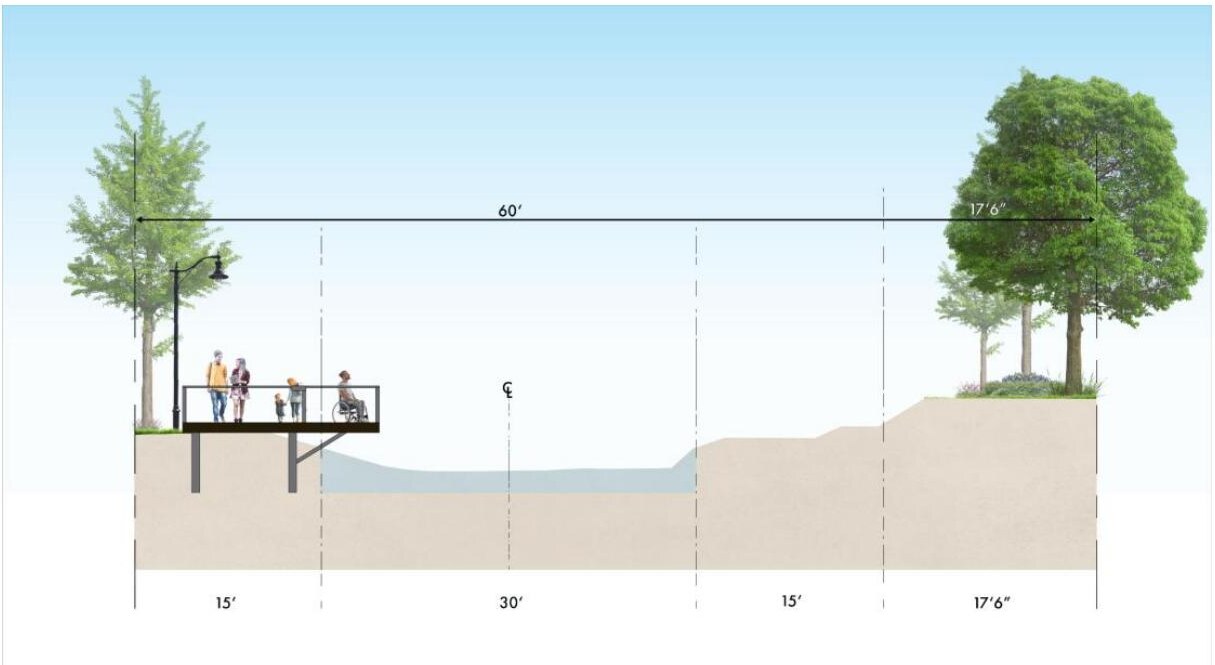
The Creekside Linear Park / Boardwalk runs roughly 1,500 linear feet along East Fork Creek, linking SE Flounder Avenue to the west and the SE Railway Avenue Extension to the east. The organic path winds around existing trees to minimize impact, creating a relaxing waterway experience modeled on West Palm Beach's Clear Lake Trail.
The SE Railway Avenue Extension adds roughly 3,000 linear feet of roadway along the FEC railway corridor, connecting the missing link between SE Cove Road and SE Salerno Road. Built on Traditional Neighborhood Development and Complete Streets principles, it optimizes traffic flow while improving bike and pedestrian mobility — especially to the New Monrovia neighborhood.
The On-Street Parking, Sidewalk and Landscape analysis found the downtown's alleyway system underutilized. By activating alleyways as the primary access to properties, on-street frontage is freed for continuous parking, uninterrupted sidewalks, street trees, and lower vehicle speeds — while relieving downtown development of parking requirements.
Port Salerno's downtown sits within the Martin County Innovation Hub — a corridor following the FEC railroad from Cove Road to Monterey Road, between US-1 and Dixie Highway. The three projects harmonize with that vision, connecting the downtown core, the marina, the southern residential neighborhood, and the new linear park into one integrated, multimodal network.